HABITS / YOUR SELF-GUIDED PLAN
The habit worked. Until a normal Tuesday happened.
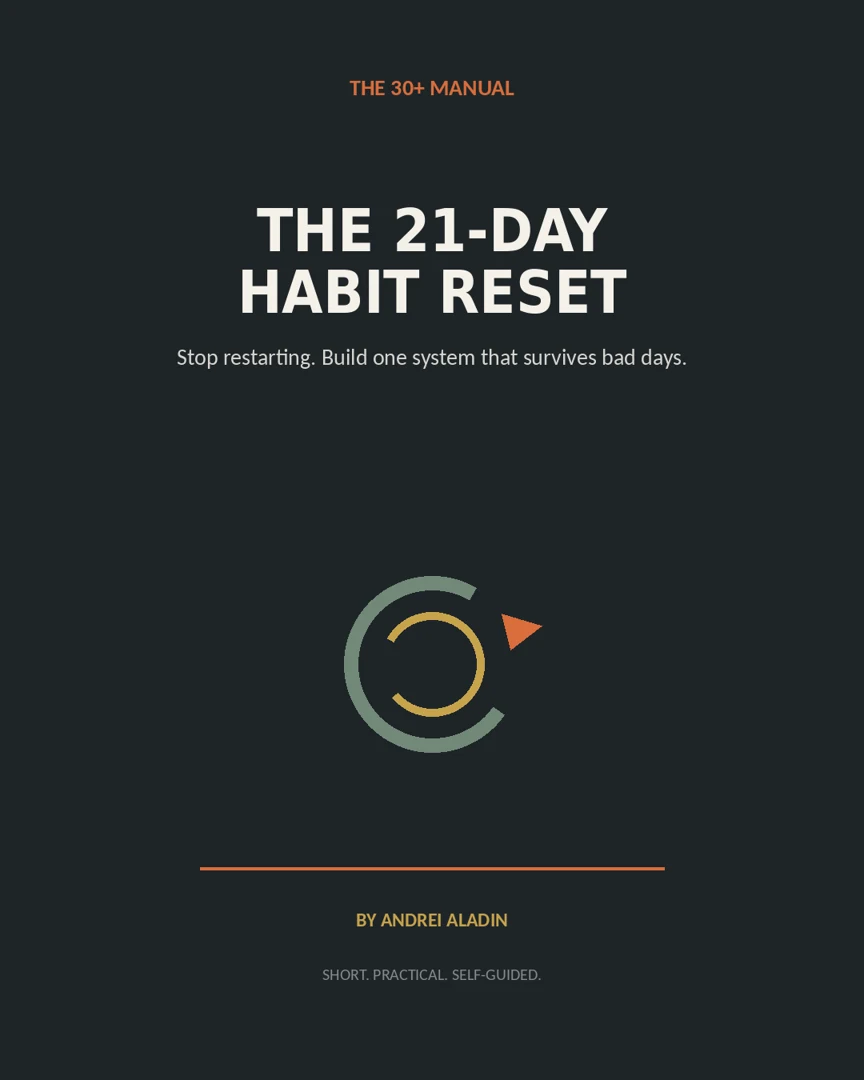
The 21-Day Habit Reset
You did it for a few days. Then a meeting ran late, a kid needed you, or the equipment was somewhere else. The plan missed one day. Somehow you lost the rest of the week. What if returning had been part of the plan from the beginning?
Self-guided PDF. No subscription. No coaching.
The part that keeps repeating.
The routine works when the day goes unusually well. That is not the day you need help with.
“Work out more” sounds reasonable until it asks you to make five decisions at once.
After a miss, you spend more time planning a restart than doing the smallest version.
Plan the return before you need it.
A repeatable behavior needs more than a good intention. It needs a visible cue, an easy first move, and a version small enough for the disrupted day. The Habit Autopsy helps you see which part keeps disappearing.
Try this: replace “read more” with “after I plug in my phone, read one page.” Then write what you will do if that cue fails. The guide helps you build this around one ordinary behavior and test it for 21 days. Twenty-one days is a test window, not a guarantee that a habit becomes automatic.
What you’ll actually use.
The tools, the job each one does, and where to find it.
- 01
Describe the pattern without judging yourself
The Habit Autopsy asks what happened before, what you did, what relief it gave you, and what made the better option harder.Page 5 in your PDF
- 02
Connect the cue to an exact action
Map cue, action, and reward. Write an if-then plan with a backup cue, so “later” stops being the whole strategy.Page 6 in your PDF
- 03
Make the first ten seconds easier
Use the friction audit to move a tool into sight, remove a competing option, or pre-decide a location. Change the setup before the difficult moment.Page 7 in your PDF
- 04
Build and practice the minimum
Write both versions. One page, one sentence, or one controlled round can be the bridge back to the fuller behavior.Page 8 in your PDF
- 05
Return, then review
The missed-day protocol tells you what to do at the next cue. Track the cue, minimum, full version, and one note; use the next-30-days page to set your maintenance rule.Page 34 in your PDF
ACTUAL PRODUCT PAGES
Look inside before you decide.
Real excerpts from the PDF you receive. Select a page to read it.
A plan for the week you actually have.
Set up one cue and its first move before Day 1. Each daily page gives you a small adjustment or review. The time required depends on the behavior you choose; the minimum version is yours to define.
- Choose one behavior, not a new morning routine with twelve parts.
- Examples cover reading, meals, movement, phone use, and writing.
- Travel, deadlines, and caregiving get a chaos version—not a character judgment.
Leave with a clearer next step.
You will leave with a cue, two sizes of the behavior, a return plan, and evidence about the setup that helped you repeat it. There is no promise that every habit becomes automatic in 21 days.
This manual is general education. It does not diagnose or treat health conditions.

THE PERSON BEHIND THE MANUALS
Useful in the middle
of an ordinary week.
Each manual starts with a check you can complete, a sequence you can try, and a way to review what happened. The aim is to make practical ideas usable without making your day revolve around the plan.
More about The 30+ ManualA few
clear answers.
What do I receive?
One 38-page PDF with 21 daily pages, setup tools, a missed-day protocol, and a next-30-days plan.
How do I receive it?
After payment is verified, download your PDF here. We also email access to your purchase library. Lava sends its own content email and keeps the purchased files in My purchases. Use an email you can access.
Do I restart the 21 days after a miss?
No. Name the practical reason, use the next available cue, and return with the minimum. Change the system if the same obstacle repeats.
What behavior should I choose?
One ordinary, observable action you want to repeat: a short walk, a reading page, or phone parking. This workbook is not treatment for addiction, dangerous compulsions, eating disorders, or other clinical problems.
Build the part of the plan that brings you back.
Self-guided PDF · 38 pages · $19 once
One payment. Your manual to keep.